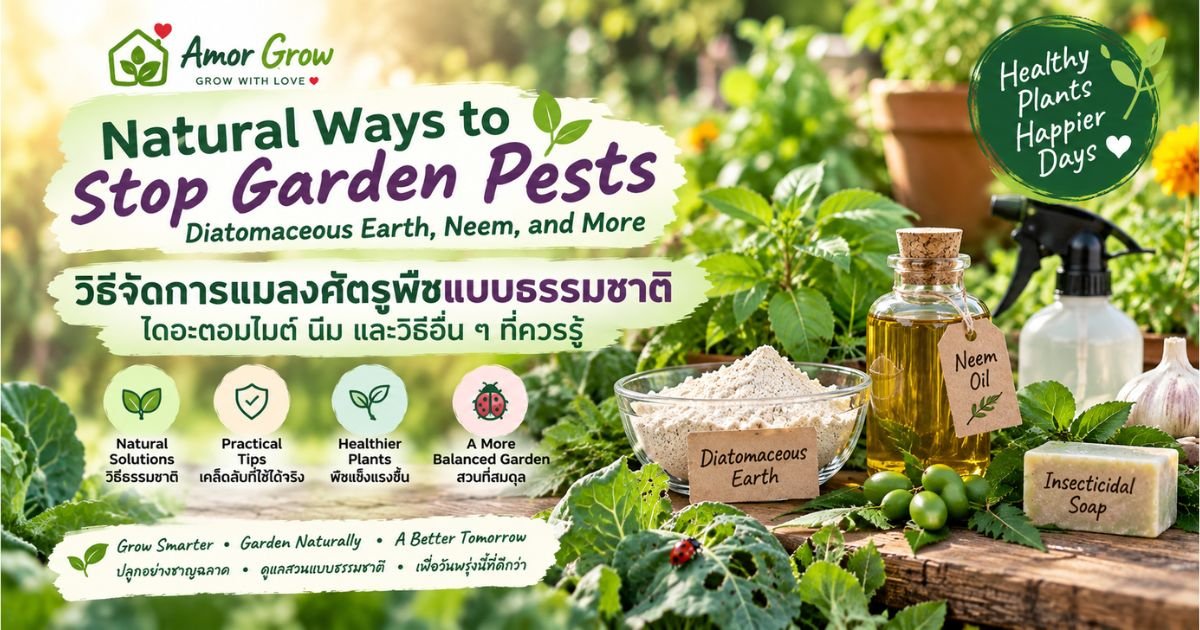
Natural Ways to Stop Garden Pests: Diatomaceous Earth, Neem, and More
Garden pests don't always require strong chemical pesticides. Learn how diatomaceous earth, neem, insecticidal soap, hand-picking, barriers, and other practical methods can help protect your plants while reducing unnecessary pesticide use.
In This Article
You walk into the garden in the morning and discover tiny holes in your kale. Aphids are gathering underneath new leaves. Something has been chewing your seedlings overnight.
It's tempting to reach immediately for a pesticide—but that doesn't always need to be the first step.
Many common garden pests can be managed using a combination of observation, physical barriers, removal, and carefully selected lower-impact treatments such as diatomaceous earth, neem, and insecticidal soap.
The key isn't finding one product that kills everything. A healthier approach is to identify the problem first and use the least disruptive method that can reasonably control it.
First: Don't Treat Every Insect as a Pest
A living garden naturally contains insects.
Some feed on plants, but others pollinate flowers, break down organic material, or prey on insects that damage our crops.
Lady beetles, lacewings, hoverfly larvae, spiders, and many other garden visitors can help keep pest populations under control.
Before treating your plants, ask:
- What insect or pest is causing the damage?
- Is the damage actually serious?
- Is it affecting one plant or spreading?
- Are beneficial insects already present?
- Can I remove the pest without using a pesticide?
This simple inspection can prevent unnecessary treatment.
1. Diatomaceous Earth
Diatomaceous earth (DE) is a powder made from fossilized remains of microscopic aquatic organisms called diatoms.
Unlike conventional insecticides that work primarily through chemical toxicity, DE acts physically. The fine particles damage the protective outer layer of susceptible crawling insects, contributing to moisture loss.
Where Can It Be Useful?
Diatomaceous earth is generally most useful against crawling pests that come into direct contact with the dry powder.
Depending on the situation, gardeners may use it as part of a management strategy for certain crawling insects around plants, containers, or growing areas.
How to Use It
Apply a very thin, targeted layer in dry areas where the pest is actually moving. More powder is not necessarily better.
DE loses much of its effectiveness when wet, so rain or irrigation may mean it needs to be reapplied after the area dries.
Important Precautions
Use a product labeled and permitted for the intended garden use, and always follow its label. Avoid inhaling the fine dust and avoid creating airborne clouds while applying it.
DE is not selective. Direct contact can also harm beneficial insects, so don't scatter it indiscriminately across flowers or places where pollinators are active.
2. Neem
Neem-based garden products are derived from the neem tree (Azadirachta indica). Depending on the formulation and active ingredients, neem products can affect certain pests in different ways.
Neem is commonly used against some soft-bodied and plant-feeding pests, but it should not be treated as a universal cure for every garden problem.
Use Neem Strategically
First identify the pest and check whether the neem product you have is labeled for that pest and crop.
When spraying leaves, coverage often matters—especially where pests are hiding on the undersides of leaves.
Follow the product's dilution, application interval, harvest restrictions, and other label instructions rather than relying on a universal homemade mixing ratio.
Protect Pollinators
Neem products can also affect non-target insects.
Avoid spraying flowers or directly spraying bees and other pollinators. Follow the label regarding application timing and precautions for pollinating insects.
Remember: being plant-derived doesn't mean a product should be used carelessly.
3. Insecticidal Soap
Insecticidal soap can be useful against certain soft-bodied pests, including aphids, whiteflies, and some mites.
It generally needs to contact the pest directly to work effectively, so spraying an empty leaf after the insects have moved away won't accomplish much.
Pay particular attention to:
- New growth
- Leaf undersides
- Stem junctions
- Other places where pests are hiding
Use a product specifically labeled as insecticidal soap and follow its directions. Ordinary household dishwashing liquid is not automatically equivalent and may contain ingredients that can injure plant tissue.
4. A Strong Spray of Water
Sometimes the simplest solution is surprisingly effective.
A firm stream of water can knock aphids and some other small pests from sturdy plants.
Pay attention to the undersides of leaves, where colonies often hide.
This is especially useful when an infestation is still small and you catch it early.
5. Hand-Picking
Not every pest needs a spray.
Caterpillars, beetles, snails, slugs, egg clusters, and visibly infested leaves can often be removed manually when the garden is small enough to inspect regularly.
Look underneath leaves and along stems, particularly early in the morning or at times when the pest is active.
For a small home garden, five minutes of inspection can sometimes prevent a small problem from becoming a large infestation.
6. Nets, Covers, and Physical Barriers
One of the best ways to deal with pests is to stop them from reaching the plant in the first place.
Fine insect netting or appropriate crop covers can help prevent certain flying insects from laying eggs or feeding on vulnerable crops.
This can be especially useful for young seedlings and vegetables that repeatedly suffer from caterpillars or other insect pests.
However, make sure pests aren't already trapped underneath the cover before closing it.
Crops that require insect pollination may also need access to pollinators during flowering.
7. Remove Heavily Infested Plant Material
If one leaf or shoot is covered with pests while the rest of the plant is relatively clean, pruning the affected portion may be easier than treating the entire plant.
Remove badly affected material from the growing area rather than leaving it next to healthy plants.
Always consider the plant's size and condition before pruning heavily.
8. Keep Plants Healthy—but Don't Overfeed Them
Good growing conditions don't make plants immune to pests, but stressed plants may be less able to tolerate damage.
Give plants appropriate light, water, spacing, drainage, and nutrition.
Avoid assuming that more fertilizer is always better. Excessive fertilization, particularly excessive nitrogen in some crops, can produce lush tender growth that may be attractive to certain pests.
9. Encourage a More Diverse Garden
A garden doesn't need to be completely insect-free to be successful.
Growing a diversity of plants and allowing suitable flowering plants to bloom can provide food and habitat for pollinators and natural enemies of garden pests.
The goal is not to create a sterile garden. It is to build a garden where pest populations can be noticed and managed before they cause unacceptable damage.
Which Method Should You Try First?
Instead of automatically spraying everything, think of pest control as a series of steps.
Step 1 — Identify.
Find out what's actually damaging the plant.
Step 2 — Inspect.
Check how widespread the problem is and look underneath leaves.
Step 3 — Remove.
If possible, hand-pick pests, remove affected leaves, or wash small pests away.
Step 4 — Prevent.
Consider netting, barriers, better spacing, or other changes that can reduce another infestation.
Step 5 — Treat selectively.
If intervention is still needed, choose an appropriate product such as insecticidal soap, neem, or diatomaceous earth based on the pest and situation.
Step 6 — Check again.
Return to the plant after treatment and see whether the population is actually decreasing.
Natural Doesn't Mean Use as Much as You Want
This is one of the most important lessons in natural gardening.
Neem comes from a plant. Diatomaceous earth comes from naturally occurring mineral material. Insecticidal soaps can have relatively low environmental persistence.
But all of them can still have unintended effects if used incorrectly.
The best pest-control product is sometimes no product at all—especially when a few minutes of hand-picking, washing, pruning, or covering the crop can solve the problem.
Observe First, Treat Second
At Amor Grow, we want gardeners to understand what's happening in their gardens rather than simply reaching for a bottle whenever they see an insect.
Observe → Identify → Protect → Treat → Monitor → Learn
The more time you spend looking closely at your plants, the easier it becomes to notice problems early.
Check new leaves. Turn leaves over. Look for eggs. Watch for holes. Notice ants moving around aphid colonies. And learn which insects are helping you.
A healthy garden isn't necessarily a garden with no insects.
It's a garden where you understand what's happening—and know when you actually need to intervene.
Safety note: Always follow the label of any commercial garden product, including instructions for crops, application rates, protective equipment, pollinator precautions, reapplication, and harvest intervals. Avoid inhaling diatomaceous earth dust. Keep garden products away from children and pets. “Natural” does not mean risk-free.